Why Does Balcony Solar Panel Efficiency Vary? The answer begins with sunlight, but it does not end there. A balcony panel may receive bright morning sun, then fall into shade behind a neighboring building. Another may face the same direction yet lose output to a railing, dusty glass, or poor airflow. Small differences matter.
Understanding what affects solar panel efficiency on balconies means looking beyond the panel’s rated power. Angle, orientation, partial shading, temperature, dirt, and inverter limits all influence the electricity a compact system produces. UC San Diego solar-energy researcher Jan Kleissl studies solar radiation and photovoltaic performance. A fair paraphrase of the practical lesson from this field is: “A panel can only use the sunlight that reaches it.” This is a paraphrase, not a verified verbatim quotation.
The details are visible in everyday use. A strip of railing shadow can cross a module at noon. Hot air trapped near a wall can warm its surface, while a loose connector or mismatched system component may constrain output. Balcony conditions also change by season, so a setup that performs well in June may produce less in December. Exact results depend on the site and equipment; estimates cannot replace measured data. Some variation is normal. The useful question is not whether every balcony can match a rooftop array, but which local conditions limit this one. This guide examines those factors and explains what owners can observe before adjusting a system. It also leaves room for uncertainty: shade patterns and real-world output are easy to underestimate.
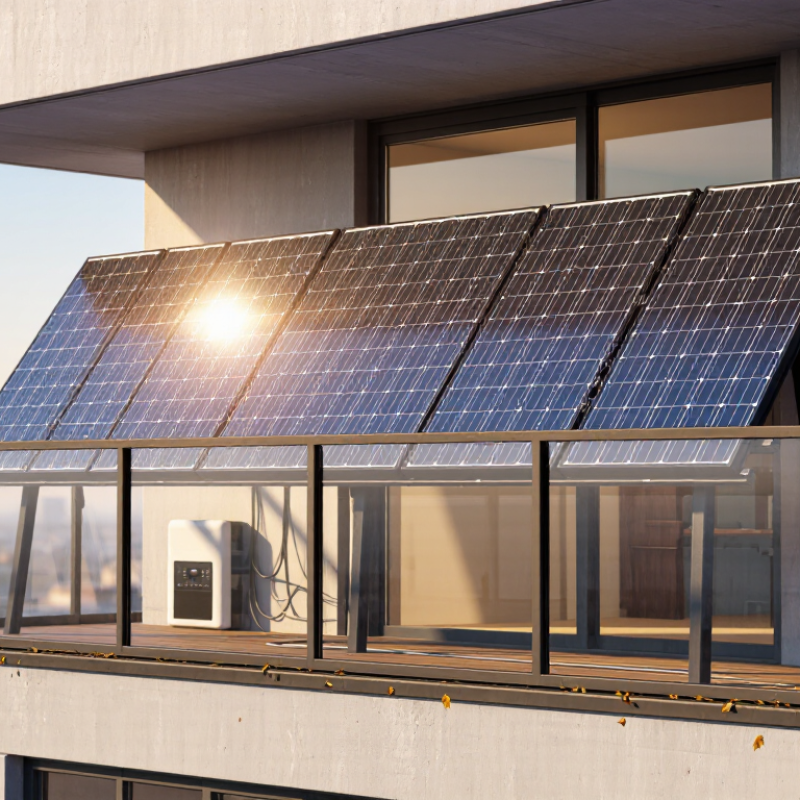
Balcony solar panel efficiency measures how much sunlight a panel converts into usable electricity. It is usually expressed as a percentage: electrical energy produced divided by solar energy falling on the panel, under defined test conditions. A higher percentage means more electricity from the same panel area. That distinction matters.
A panel’s rated efficiency is not the same as the electricity it produces at home. Standard tests use controlled light and temperature, while a balcony may have railings, nearby buildings, or passing shadows. Even a narrow strip of shade can reduce output. Heat, panel angle, and inverter losses also affect the electricity reaching your outlet.
For everyday tracking, a meter or inverter reading in kilowatt-hours is often more useful than a headline efficiency figure. It shows actual energy production over a day or month, though it does not measure sunlight reaching the panel. Comparing readings across similar weather and seasons can help reveal changes. I would not label a low reading “poor efficiency” without checking shade and orientation first; that judgment can be too quick. The measurement has limits.
Balcony solar output starts with the sunlight that actually reaches the panel. A south-facing panel generally receives stronger midday sun in the Northern Hemisphere; in the Southern Hemisphere, north-facing placement is often more favorable. East-facing panels tend to catch morning light, while west-facing ones collect more afternoon sun. The best direction still depends on nearby buildings, balcony depth, and seasonal sun paths. A compass reading alone can mislead.
Shading matters even when it covers only part of a panel. A railing bar, tree branch, or neighboring balcony can cast a narrow shadow across cells and reduce output. NREL’s PVWatts Version 8 documentation uses a 14% default allowance for combined system losses, including shading, soiling, wiring, and mismatch. That figure is a modeling assumption, not a prediction that every balcony loses exactly 14%. Small systems also vary with panel angle and local weather.
Watch the shadow line. Check it at several times of day, then compare readings across clear days. A single afternoon is weak evidence; clouds and reflections can distort the result. PVGIS, the European Commission’s photovoltaic yield assessment tool, also models location, tilt, and orientation when estimating solar production. Real balconies are messier than model inputs, so treat estimates as a starting point, not a promise.
| Balcony conditions | Peak sun hours per day | Panel orientation | Approx. orientation factor | Estimated shading loss | Estimated energy from one 400 W panel |
|---|---|---|---|---|---|
| Open balcony, direct sun most of the day | 4.0 | South-facing | 1.00 | 0% | ≈1.28 kWh/day |
| Open balcony, direct sun most of the day | 4.0 | Southeast- or southwest-facing | 0.95 | 0% | ≈1.22 kWh/day |
| Open balcony, direct sun for part of the day | 3.0 | East- or west-facing | 0.82 | 0% | ≈0.79 kWh/day |
| South-facing balcony with brief railing or building shade | 4.0 | South-facing | 1.00 | 10% | ≈1.15 kWh/day |
| South-facing balcony with recurring partial shade | 4.0 | South-facing | 1.00 | 25% | ≈0.96 kWh/day |
| East-facing balcony with limited morning sun | 2.5 | East-facing | 0.82 | 10% | ≈0.59 kWh/day |
| North-facing balcony, mostly indirect light | 2.0 | North-facing | 0.55 | 0% | ≈0.35 kWh/day |
Estimates are illustrative, not a site-specific forecast. They assume a Northern Hemisphere location, a 400 W panel, and a system performance ratio of 0.80; energy is estimated as panel capacity × peak sun hours × orientation factor × unshaded fraction. Actual output varies with location, season, panel tilt, weather, temperature, and electrical setup. Partial shade can cause larger-than-proportional losses, depending on the panel and system design.
Balcony solar output responds to sunlight, not simply to whether the sky looks bright. Thin cloud can reduce direct light, while a clear, cool morning may produce steady power. Readings can dip when a passing cloud crosses the sun. They can also jump briefly near a cloud’s edge, where reflected light adds to the panel’s exposure. Small shadows matter. A railing, nearby wall, or even a plant can cover part of a panel and cut output more than expected.
Temperature changes performance in a less obvious way. Sunlight heats the cells, and many panels produce less power as cell temperature rises above their rated test conditions. A hot, still afternoon can therefore yield less electricity than a crisp sunny morning. Air temperature alone does not tell the whole story; dark panel surfaces can become much hotter than the surrounding air. Leave airflow behind the panel, following its mounting guidance. A cold panel can perform well in strong sun. Wind may cool it, though gusts and shifting clouds also make readings uneven.
It is tempting to judge performance from one sunny day. That can mislead. Note the time, weather, and shading beside each reading for a week or two. The pattern may be messier than expected.
A balcony panel rarely faces an ideal, open sky. Its direction, tilt, and nearby obstructions shape how much sunlight reaches it. A railing can shade the lower cells; a neighboring wall may block late-afternoon light. Small shadows matter. Partial shading can reduce output more than its covered area suggests, especially when panels share one electrical string.
System choices matter too. NREL’s PVWatts documentation uses a 14% default allowance for common system losses, including wiring, mismatch, and soiling. That figure models a typical system; it is not a prediction for every balcony. Fraunhofer ISE’s Photovoltaics Report describes modern inverter peak efficiencies around 98%, but peak figures do not guarantee that performance in real conditions. An inverter operating away from its efficient range, or poorly matched to the panel, can reduce usable energy.
Mounting details are easy to overlook. Leave space behind the panel for airflow, keep connectors dry and secure, and avoid unnecessarily long cable runs. Heat can lower panel output, while loose connections add losses and safety concerns. A microinverter or separate tracking inputs may help limit the effect of uneven shade, depending on the system design. Still, no component can recover sunlight blocked by a balcony above. Compare daily energy readings across sunny and cloudy weeks; the pattern may reveal a problem, though weather makes the evidence imperfect.
Balcony solar output is easiest to compare when you track energy, not just the panel’s advertised power. Record daily production in kilowatt-hours (kWh) from the system’s display or monitoring app. Check readings at the same time each day, and note the date, cloud cover, and any shade from railings or nearby buildings. Small shadows matter.
Compare several weeks, not one sunny afternoon. A useful measure is daily kWh divided by the system’s rated kilowatts. This helps account for different system sizes, though it cannot remove every difference in panel age, angle, or equipment. Keep the comparison fair: use similar dates and seasons, and record whether panels were tilted or cleaned. Don’t compare a clear spring day with a cloudy winter one.
A simple spreadsheet works. Add columns for date, output, weather, and shading. If readings come from a household meter, confirm that it measures solar production rather than total home use. App data can arrive late or be rounded, so treat tiny differences cautiously. The comparison will still be imperfect. That is worth admitting. A passing shadow, missed reading, or changed panel angle can distort the pattern, and real balconies rarely offer laboratory conditions.
No. Thin clouds can reduce direct sunlight, while a clear, cool morning may produce steady power.
Yes. A cloud crossing the sun can lower readings. Reflected light near a cloud’s edge may briefly raise them.
Panel cells can lose efficiency as they heat above rated test conditions. A dark panel may become much hotter than the surrounding air.
More than expected. A railing, nearby wall, or plant covering part of a panel can reduce output.
Note daily energy in kWh, the date, cloud cover, and nearby shade. Check readings at the same time each day.
Divide daily kWh by the system’s rated kilowatts. This helps, but panel angle, age, and equipment still affect comparisons.
Not reliably. Use similar seasons and dates, and note whether panels were tilted or cleaned. A cloudy winter day is not a fair match for a clear spring day.
No. App data may arrive late or be rounded, and a household meter may show total home use instead. Tiny differences are easy to overread.
Try a week or two, or compare several weeks. The pattern may still be messy; one missed reading or shifting shadow can distort it.
Balcony solar panel efficiency describes how effectively a system turns available sunlight into usable electricity. What affects solar panel efficiency on balconies includes the amount of direct sunlight, the direction and angle of the panels, and shading from nearby buildings, railings, or trees. Even small changes in sun exposure throughout the day can lead to noticeable differences in output.
Weather and temperature also matter: cloudy conditions reduce incoming sunlight, while excessive heat can lower panel performance. Installation quality, secure positioning, wiring, and the condition of system components can further influence how much power reaches your home. To measure and compare balcony solar output, track energy production over time and consider the weather, season, and hours of sunlight. Comparing readings under similar conditions offers a more useful picture of performance than relying on a single day’s result.
PlugVolt Charging